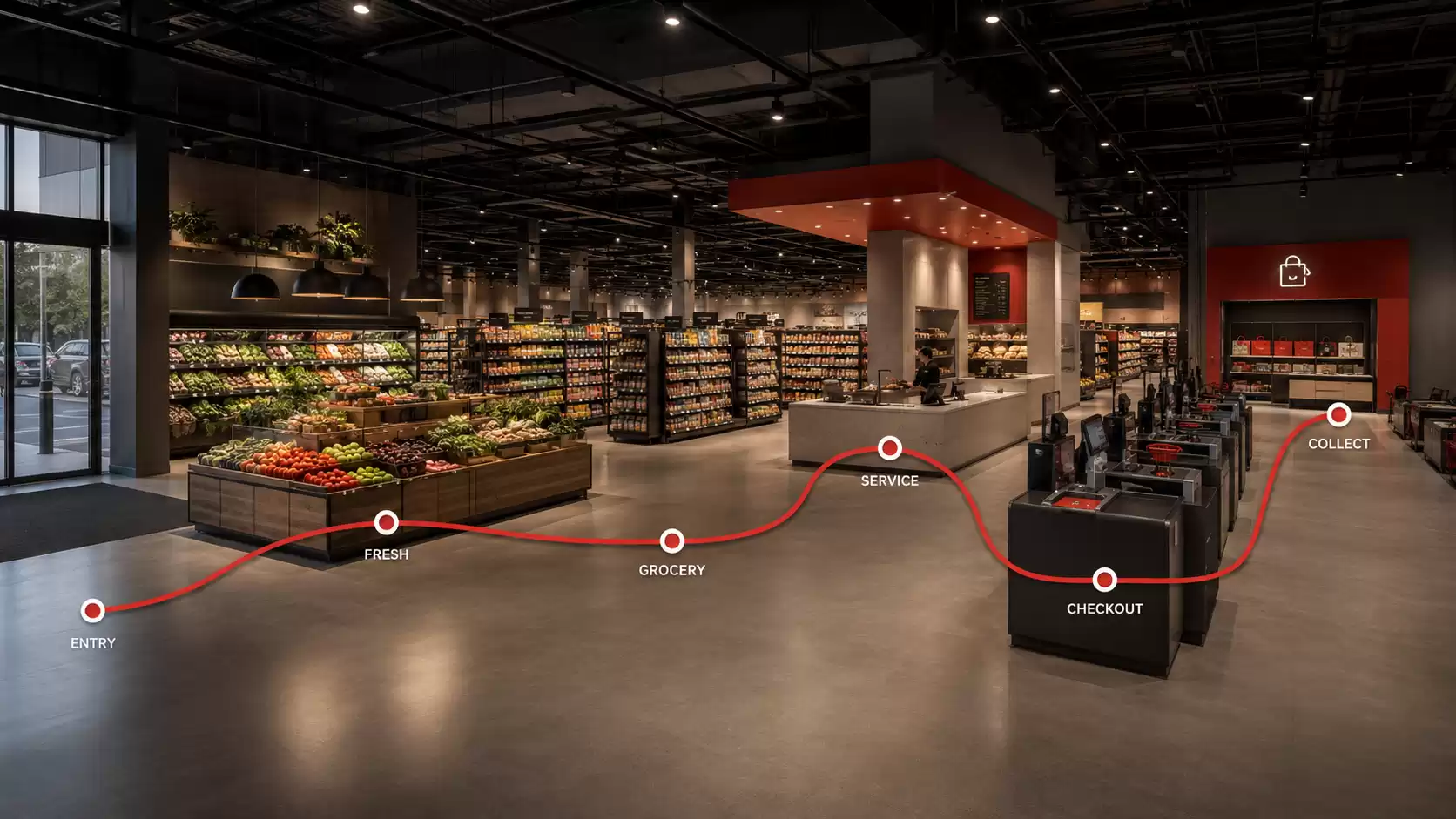
How Customer Journey Planning Influences Large-Format Store Performance
Customer journey planning has a direct influence on how well a large-format retail environment performs. This is particularly true in major supermarkets, where high customer volumes, broad product ranges and complex operational requirements must work together across an extensive footprint.
Customers expect value and convenience, but they also want a faster, clearer and more comfortable shopping experience. Delivering that experience requires every part of the store, from entry and fresh food through to checkout and collection, to be planned around how people move, shop and interact with the environment.
Understanding the Supermarket Customer Journey
A supermarket visit may appear straightforward, but customers enter the store with different needs.
Some are completing a full weekly shop. Others want to collect a few items quickly, visit a service counter or pick up an online order. A successful layout must support these different journeys without making the store difficult to understand or navigate.
Clear entry points, logical category placement and visible destination departments help customers orient themselves quickly. When movement feels intuitive, shoppers can find products more easily and experience less friction throughout their visit.
Using Layout to Support Store Performance
The customer journey is shaped by a series of practical layout decisions.
Aisle widths, fixture heights, sightlines and category adjacencies all influence how customers move through the store. Fresh food departments need to feel accessible and easy to explore, while promotional zones must attract attention without creating congestion.
In large supermarkets, these decisions also affect stock replenishment, trolley movement and staff access. A layout that supports the customer journey while accounting for operational requirements can help the store remain efficient during busy trading periods.
Creating Clear and Flexible Product Zones
Supermarkets must present a significant volume of stock while keeping categories clear and manageable.
Fixture systems play an important role in creating this balance. They establish product zones, support visibility and help customers understand where one category ends and another begins. The right fixture heights and configurations can improve sightlines across departments while maintaining the required stock density.
Flexibility is also essential. Modular fixtures allow retailers to respond to promotional programs, seasonal ranges, changing customer expectations and new service formats without unnecessarily disrupting the broader store layout.
Connecting Front-of-House and Operational Flow
Store performance depends on more than what customers see.
Major supermarkets operate with constant stock movement, frequent replenishment, long trading hours and complex back-of-house requirements. Customer routes must therefore be considered alongside staff workflows, loading access, storage and service areas.
Planning these movements together can reduce points of conflict between customers, staff and replenishment activities. It also helps departments maintain product availability and presentation throughout the trading day.
Reducing Friction at Checkout and Collection
The final stage of the customer journey can have a significant effect on the overall store experience.
Traditional checkouts, self-service areas, express lanes and service counters need to be planned around queue movement, accessibility and customer choice. Poorly positioned fixtures or unclear pathways can create congestion, even when the rest of the store works effectively.
Click and collect adds another layer to this journey. Collection points should be easy for customers to locate while allowing staff to prepare and transfer orders efficiently.
Integrating Technology into the Physical Environment
Technology is increasingly part of the large-format supermarket experience.
Electronic shelf labels, digital signage, queue management systems and online order collection can improve convenience and store efficiency. However, these systems only add value when they are properly integrated with the fixtures, services and physical layout.
Planning for technology early helps ensure screens, labels, power, data and collection infrastructure support the customer journey without appearing disconnected from the store environment.
Building Performance Through Practical Decisions
In major supermarkets, strong performance rarely comes from one design feature. It is usually the result of many practical decisions working together across the customer journey.
Retail Fixtures Australia understands the demands of large-format retail environments. Our focus is on fixture systems and layouts that support product presentation, efficient replenishment, changing retail requirements and an easier shopping experience.
Planning a supermarket fit-out, refurbishment or fixture program? Speak with Retail Fixtures Australia about creating a practical large-format retail environment designed around customers and day-to-day performance.